


Leakage at a titanium flange connection should be reviewed against the complete piping interface, not judged by the flange material alone. For an ASTM titanium flange used in an ASME-related piping or equipment connection, the final result depends on dimensional fit, facing condition, gasket selection, bolt loading, pipe alignment, and the conditions at the installation site.
A structured inspection helps determine whether the problem is related to the component, the connection design, or the installation process. It also gives the buyer and supplier a clear checklist for reviewing the drawing, mating parts, and project requirements before a replacement flange is ordered.
Start with the Interface, Not the Material Label
The description "titanium flange" does not contain enough information to evaluate a piping joint. The review should begin with the applicable ASTM material requirement, the dimensional standard or customer drawing, and the connection to which the flange will be fitted.
Confirm the pipe outside diameter, bore, flange thickness, outside diameter, bolt circle, number of bolt holes, hole diameter, and orientation. If the connection is custom or interfaces with equipment, the mating drawing should be checked rather than relying only on a nominal size or general product description.

Four Areas to Review When Leakage Appears
1. Pipe and Equipment Alignment
The pipe should approach the flange naturally and align with the mating connection. If installers need to pull, push, or rotate the pipe to bring the bolt holes together, the joint may be carrying avoidable stress. This condition can affect the contact between the facing surfaces and may contribute to leakage after the system is put into service.
2. Facing and Gasket Compatibility
The facing arrangement and gasket must be considered as one sealing interface. Check that the gasket dimensions correspond to the flange face and that its material and design are suitable for the service medium and operating conditions defined by the project. A correct flange dimension does not compensate for a gasket that is unsuitable or incorrectly positioned.
3. Bolt Pattern and Load Distribution
Review the bolt-hole pattern, fastener arrangement, washer or nut requirements where specified, and the tightening procedure. Uneven loading can leave part of the sealing face with insufficient contact pressure. Progressive tightening in a suitable sequence is generally used to help develop a more balanced joint, subject to the project's approved installation procedure.
4. Installation Access and Site Constraints
A flange may meet the drawing requirements and still be difficult to install if the surrounding space is restricted. Check access for positioning the gasket, inserting fasteners, using tightening tools, inspecting the connection, and carrying out later maintenance. These practical constraints should be identified before a replacement or custom flange is finalized.
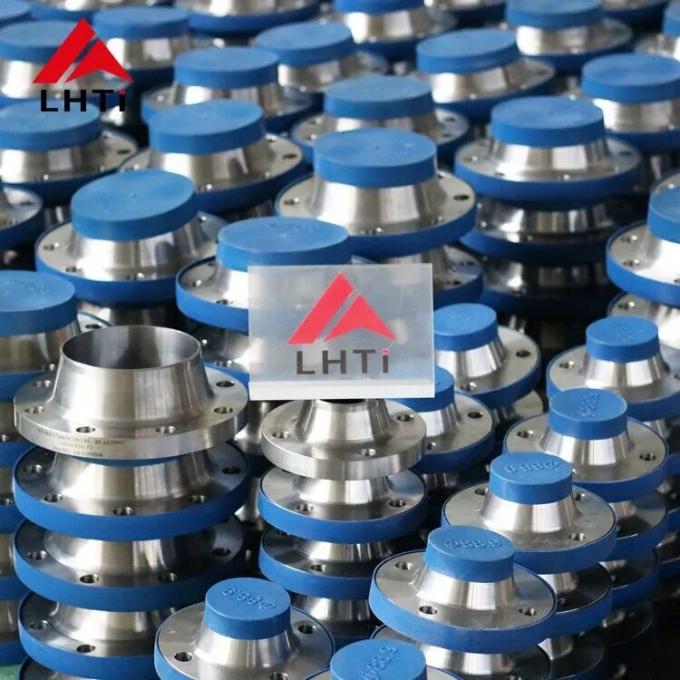
Pre-Installation Checklist for Titanium Flange Connections
- Compare the flange drawing with the applicable ASTM, ASME, project, or customer requirements.
- Verify the pipe outside diameter, bore, connection dimensions, and mating equipment interface.
- Check the bolt circle, hole count, hole diameter, orientation, and fastener arrangement.
- Inspect the mating faces and remove contamination or foreign material according to the project procedure.
- Confirm that the gasket type, dimensions, position, and service suitability have been reviewed.
- Make sure the pipe can be aligned without using the bolts to force the connection into position.
- Follow the approved tightening sequence and installation requirements.
- Record any unresolved dimensional or sealing issue before final assembly or replacement ordering.
Information to Include in a Replacement or New-Flange Inquiry
| Project Information | Engineering Review Focus |
|---|---|
| ASTM material requirement and applicable design reference | Material and dimensional basis for the quotation |
| Pipe outside diameter, bore, flange dimensions, and thickness | Connection and fit-up compatibility |
| Bolt circle, hole count, hole size, and orientation | Assembly alignment with the mating component |
| Facing, sealing structure, and gasket information | Compatibility of the complete sealing interface |
| Service medium, temperature, pressure, and corrosion environment | Application context for material and sealing review |
| Equipment drawing, photographs, and installation-space limitations | Practical access and maintenance assessment |
A Better Way to Analyze Flange Leakage
When leakage is reported, replacing the flange without reviewing the connection may leave the original cause unresolved. A more reliable approach is to compare the flange drawing, pipe alignment, bolt pattern, facing, gasket arrangement, and installation conditions as one set of information.
This review is also useful before production. Complete technical input allows the manufacturer to identify missing dimensions, clarify the connection relationship, and confirm which requirements still need approval. It reduces the risk of receiving a component that matches a general description but does not suit the actual equipment interface.
Technical Support for Titanium Flange Projects
Lihua Titanium Industry has focused on titanium materials and titanium products for nearly 20 years. For ASTM titanium flanges, ASME-related piping connections, and customer-drawing requirements, buyers are encouraged to provide the available dimensional drawings, facing and gasket details, bolt-hole layout, service environment, and installation limitations.
Send your titanium flange drawing and connection data for a fit and sealing review before requesting final production.


