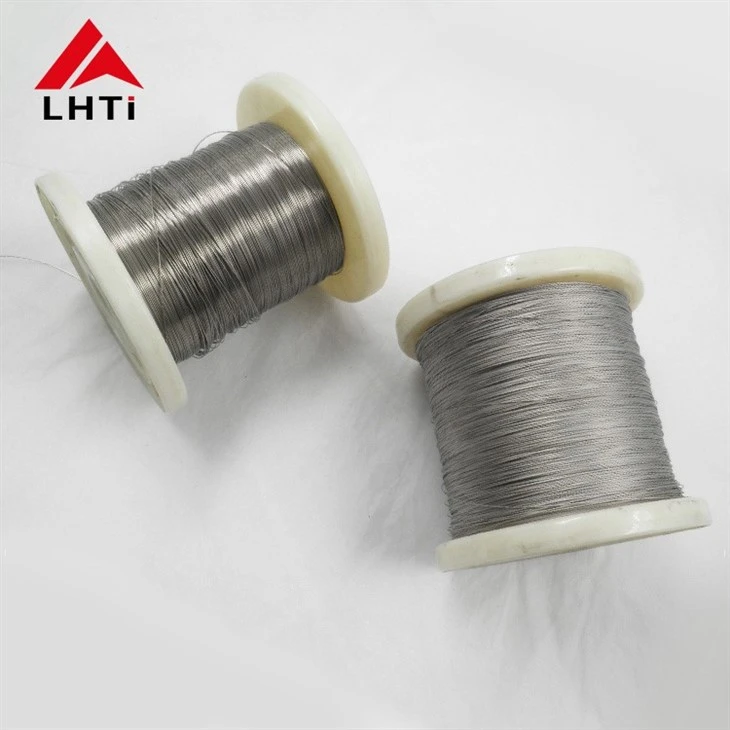
Hey there! I'm a supplier of titanium wire, and I've been in this industry for quite a while. One of the most crucial aspects of our business is controlling the quality during the titanium wire manufacturing process. In this blog, I'll share some of the key steps and strategies we use to ensure that our titanium wire meets the highest standards.
Raw Material Selection
The first and most important step in quality control is choosing the right raw materials. Titanium is a unique metal, and its quality can vary greatly depending on its source and composition. We always source our titanium from reliable suppliers who can provide us with detailed information about the material's chemical composition, purity, and mechanical properties.
We specifically look for titanium that meets industry standards such as ASTM F136/F1341. This standard ensures that the titanium has the right purity and properties for various applications. You can find more information about ASTM F136/F1341 Pure Titanium Wire Titanium Weld Wire on our website. Before using any raw material, we conduct our own tests to verify its quality. This includes chemical analysis, hardness testing, and visual inspection. Any material that doesn't meet our strict criteria is rejected.
Melting and Casting Process
Once we have the right raw materials, the next step is the melting and casting process. This is where the titanium is transformed into ingots, which will later be processed into wire. We use advanced melting techniques, such as vacuum arc remelting (VAR), to ensure that the titanium is melted evenly and that any impurities are removed.
During the casting process, we pay close attention to the temperature and cooling rate. These factors can have a significant impact on the microstructure and properties of the ingot. We use state - of - the - art equipment to monitor and control these parameters in real - time. If the temperature or cooling rate deviates from the set values, we make immediate adjustments to ensure that the ingot has the desired quality.
Forging and Rolling
After the ingot is cast, it goes through a forging and rolling process to reduce its diameter and improve its mechanical properties. Forging helps to break down the large grains in the ingot and create a more uniform structure. We use hydraulic presses to apply precise pressure during the forging process.
Rolling further refines the wire's shape and properties. We have multiple rolling mills that can gradually reduce the diameter of the wire to the desired size. During rolling, we continuously monitor the wire's dimensions and surface finish. Any wire that has an incorrect diameter or a poor surface finish is removed from the production line.

Heat Treatment
Heat treatment is a critical step in the titanium wire manufacturing process. It helps to relieve internal stresses, improve the wire's ductility and strength, and enhance its corrosion resistance. We use different heat treatment methods, such as annealing and solution treatment, depending on the specific requirements of the wire.
For example, ASTM F136 Titanium Wire often requires specific heat treatment to achieve its excellent corrosion resistance. We carefully control the temperature, time, and atmosphere during heat treatment. If the heat treatment process is not carried out correctly, the wire may not have the desired properties.
Drawing and Finishing
The drawing process is used to further reduce the diameter of the wire and improve its surface quality. We use a series of dies to gradually draw the wire to the final size. During drawing, we apply lubricants to reduce friction and prevent surface damage.
After drawing, the wire goes through a finishing process. This includes cleaning, straightening, and cutting. We use ultrasonic cleaning to remove any contaminants from the wire's surface. Straightening ensures that the wire is perfectly straight, which is essential for many applications. Cutting is done with high - precision cutting equipment to ensure that the wire has the correct length.
Quality Testing
Throughout the manufacturing process, we conduct a series of quality tests to ensure that the titanium wire meets our standards. These tests include:
- Dimensional Testing: We use calipers, micrometers, and other measuring tools to check the diameter, length, and straightness of the wire. Any wire that is out of the specified tolerance range is rejected.
- Mechanical Testing: Tensile testing, hardness testing, and fatigue testing are carried out to evaluate the wire's mechanical properties. We want to make sure that the wire has the right strength, ductility, and fatigue resistance for its intended application.
- Chemical Analysis: We use spectroscopy and other analytical methods to verify the chemical composition of the wire. This ensures that the wire has the correct amount of titanium and other alloying elements.
- Surface Inspection: Visual inspection and non - destructive testing methods, such as eddy current testing, are used to check the wire's surface for any defects, such as cracks, scratches, or inclusions.
Traceability
We understand the importance of traceability in the quality control process. Every batch of titanium wire we produce is assigned a unique identification number. This number is used to track the wire from the raw material stage all the way through to the finished product. We keep detailed records of all the processes, tests, and inspections carried out on each batch of wire. This allows us to quickly identify and address any quality issues that may arise.
Continuous Improvement
Quality control is not a one - time thing; it's an ongoing process. We are constantly looking for ways to improve our manufacturing processes and quality control methods. We invest in research and development to stay up - to - date with the latest technologies and industry best practices.
We also encourage feedback from our customers. If a customer has any issues with our titanium wire, we take it very seriously and work hard to resolve the problem. We use this feedback as an opportunity to learn and make improvements to our products and processes.
Conclusion
Controlling the quality during the titanium wire manufacturing process is a complex but essential task. By carefully selecting raw materials, using advanced manufacturing techniques, conducting rigorous quality testing, and maintaining traceability, we can ensure that our titanium wire meets the highest standards.
If you're in the market for high - quality titanium wire, such as Titanium Grade 7 Welding Wire, don't hesitate to reach out to us. We're always happy to discuss your specific requirements and provide you with the best solutions. Let's start a conversation and see how we can work together to meet your needs.
References
- ASTM International Standards for Titanium Materials
- Industry research reports on titanium wire manufacturing
- Technical literature on metal processing and quality control