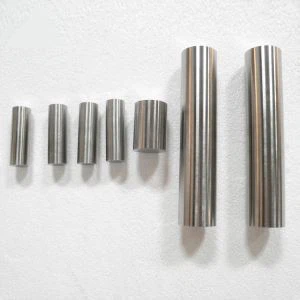
Hey there! I'm a supplier of molybdenum bars, and today I want to chat about the ferroelectricity of a molybdenum bar. Now, you might be scratching your head and wondering, "What on earth is ferroelectricity, and what does it have to do with molybdenum bars?" Well, stick around, and I'll break it all down for you.
First off, let's get a basic understanding of ferroelectricity. Ferroelectricity is a property of certain materials where they can have a spontaneous electric polarization that can be reversed by the application of an external electric field. It's kind of like having a built - in electric charge that you can flip around with the push of an electric button, so to speak. This property is pretty cool because it has a whole bunch of applications in electronics, like in memory devices, sensors, and actuators.
Now, when it comes to molybdenum bars, things get a bit more interesting. Molybdenum is a metal, and typically, metals aren't known for being ferroelectric. Metals are usually good conductors of electricity, which means they let electrons flow freely through them. Ferroelectric materials, on the other hand, have a more complex internal structure that allows for this spontaneous polarization.


But here's the deal. Under normal circumstances, a pure molybdenum bar doesn't exhibit ferroelectricity. Molybdenum has a body - centered cubic (BCC) crystal structure at room temperature. In this structure, the atoms are arranged in a way that doesn't support the kind of internal electric dipole arrangements needed for ferroelectricity. The electrons in molybdenum are delocalized, meaning they can move around easily throughout the metal lattice, and this doesn't create the stable polarization states required for ferroelectric behavior.
However, things can change if we start to mess with the molybdenum bar's structure or composition. For example, if we dope the molybdenum with certain impurities or create specific surface or interface conditions, we might be able to induce some ferroelectric - like behavior. Doping is when we add small amounts of other elements to the molybdenum. These dopants can disrupt the regular crystal structure of molybdenum and create regions where the electric dipoles can align in a more ordered way.
Another way is to create molybdenum - based thin films or nanocomposites. When we make molybdenum into very thin layers or combine it with other materials at the nanoscale, the surface and interface effects become much more important. At these small scales, the quantum effects start to play a big role, and we might be able to see some ferroelectric - like properties emerging. For instance, if we deposit a molybdenum thin film on a substrate with a specific crystal structure, the interface between the molybdenum and the substrate can cause the molybdenum atoms to rearrange in a way that promotes electric polarization.
Now, you might be thinking, "Okay, that's all well and good, but why does it matter?" Well, if we can make molybdenum bars or molybdenum - based materials ferroelectric, it opens up a whole new world of applications. In the field of electronics, ferroelectric molybdenum could be used to create high - density memory devices. These devices could store more data in a smaller space and have faster read and write times compared to traditional memory technologies.
In sensors, ferroelectric molybdenum could be used to detect very small changes in electric fields. This could be useful in environmental monitoring, where we need to detect trace amounts of certain chemicals that can affect the local electric field. And in actuators, ferroelectric molybdenum could be used to convert electrical energy into mechanical motion very efficiently. This could be used in things like micro - robots or precision positioning systems.
As a molybdenum bar supplier, I'm always on the lookout for new and exciting applications for our products. We offer a wide range of molybdenum bars, including Molybdenum Round Bar and Molybdenum Rod. Our products are of high quality, and we can work with you to customize the molybdenum bars according to your specific needs. Whether you're a researcher looking to experiment with creating ferroelectric molybdenum or a manufacturer looking for reliable molybdenum bars for your products, we've got you covered.
If you're interested in learning more about our molybdenum bars or want to discuss potential applications, especially in the context of exploring ferroelectricity, don't hesitate to reach out. We're here to help you make the most of molybdenum's unique properties.
In conclusion, while a pure molybdenum bar isn't ferroelectric under normal conditions, there are ways to modify it to exhibit ferroelectric - like behavior. This has the potential to revolutionize various industries, from electronics to sensors and actuators. As a supplier, I'm excited to be part of this journey and see where the research on ferroelectric molybdenum takes us. So, if you're in the market for molybdenum bars, give us a chance to be your go - to supplier.
References
- Ashcroft, N. W., & Mermin, N. D. (1976). Solid State Physics. Holt, Rinehart and Winston.
- Cady, W. G. (1946). Piezoelectricity: An Introduction to the Theory and Applications of Electromechanical Phenomena in Crystals. McGraw - Hill.